|
Banks & Banking
Opening a Bank account
There
are many banks in the UK that will let you open an account; you will
need one so that your employer can automatically transfer your salary to
you. It is a good
idea
to shop around as banks compete for your business and rates can vary on
current and savings accounts.
The UK
has seen a lot of change in the retail banking market, with the rise of
internet only accounts, or building societies (owned by their members)
which have turned into banks (responsible to shareholders).
Many
people use one of many ‘high street’ banks, so called as they have
a branch in the main street of most towns. You will generally be able to
manage your account online
Taking money out of your Bank Account
Once
you have opened an account, your bank will issue you with a bank card to
allow you to withdraw money from one of many ATMs (Automated Telling
Machines). You will generally be able to withdraw cash from ATMs owned
by other banks, but check first that they, or your own bank, will not
charge you for this.
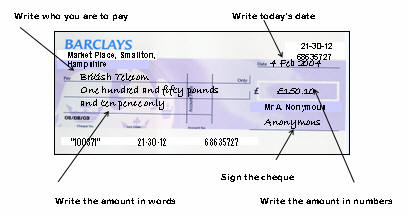
Your bank will also provide you with a
cheque
Book. Each
cheque is a written authorisation to pay money from an account to
someone else (called the payee). You can only use this cheque in the
country it is issued and in the currency of that country. The diagram
below shows you how a cheque should be filled in before it is presented.
Paying money into your account
You
can pay money into your account either at the bank in person or by post if you
are paying in a
cheque
from
somebody else.
You will need to fill in a paying in slip (supplied with your cheque
book) with the details of your account and the amount you are paying in.
Be
aware that if you are paying in a
cheque
or transferring money online, it can often take a few days until the
money will be available in your account.
Credit Cards
Most
banks will offer you a credit card (effectively a loan). There are many
companies that specialize in offering you a credit card, without you
actually having a bank account with them. It is worth shopping around
for the best rate of interest on your credit card balance.
Mortgages
You may
consider buying a property in the UK, most banks and building societies
offer a loan (mortgage) of up to 95% on the purchase price and is
generally repayable over a number of years (usually 25).
You
have different options on which mortgage to chose (they can be quite
confusing!) but they generally are based on you paying back the interest
with the capital paid at the end of the duration of the loan or paying
back capital and interest together. It is a good idea to speak to a
mortgage advisor such as
Charcol
Online
Don’t
forget also that you will also have to pay stamp duty when purchasing a
property, which is a tax
payable to the government based on the value of the property. Currently
stamp duty is 1% on a property valued at under £250,000.
|